In search of the "right answer."


Welcome to The Unlock, a newsletter focused on cutting through the multifamily tech “noise” to show what actually matters in AI, leasing, and marketing. Each issue delivers market insights, technology trends, and deeper analysis on selected topics to see if there’s actually substance behind the hype.
Brought to you by Peek, the AI-powered leasing automation platform helping multifamily owners lease up to 30% faster.

Sam Altman, CEO of Open AI, just provided a glimpse into the future of how people might buy everything—including renting an apartment.
In an interview on “Conversations with Tyler,” Altman pointed out that Google ads only work when Google is doing a poor job. If the “right answer” consistently showed up at the top, there would be no reason to pay to pin an ad there.
ChatGPT is monetized, but not ad based. When you pair that with the fact that people are now having full conversations with AI tools to make decisions, it creates a very different kind of trust.
If Altman is right and consumers are starting to trust AI search tools more than Google, it’s because they are positioning themselves as answer engines, not search engines.
A search engine is about giving you possible paths. An answer engine tries to help you make the decision. That structural difference changes the emotional contract. Going down a rabbit hole with ChatGPT to find the perfect pair of winter boots — based on your climate, budget, taste, commute, and even political values — feels less like searching and more like collaborating.
You can feel the trust element show up in the outrage over AI “hallucinations.” A hallucination is when a chatbot doesn’t know something and invents it. When this happens, people aren’t just annoyed – they feel betrayed. The emotional expectation isn’t “give me some URLs," it’s “help me get to the right answer.
Google, by comparison, has always been a directory: ten blue links, three ads, and maybe a Reddit thread. It’s information, not an answer. Google has never promised “the best answer.” Think about the “I’m feeling lucky” button.
If consumers increasingly trust LLMs to help them solve big life decisions (and the right answer cannot be bought), what does this mean for the future of property marketing?
Early movers in AI discoverability have a big advantage
Our product team recently ran an analysis on 58,158 communities to simulate thousands of possible queries that real renters are asking. Of that data, more than three quarters are essentially invisible, appearing less than 0.5% of the time. Meanwhile, the top 5% of performers are getting half of the AI mentions.

This is not a gradual curve. It’s a cliff. With Google search, there are ten links on the first page. Maybe more if someone is motivated enough to click to page two. Being at the top matters, but there is still a slope where other results can earn attention.
With AI search, only a handful of results surface, and sometimes just one. If you wait to optimize, you are not slowly slipping behind. You are disappearing while your competitors capture market share.
How a Renter Actually Searches Inside an AI Tool
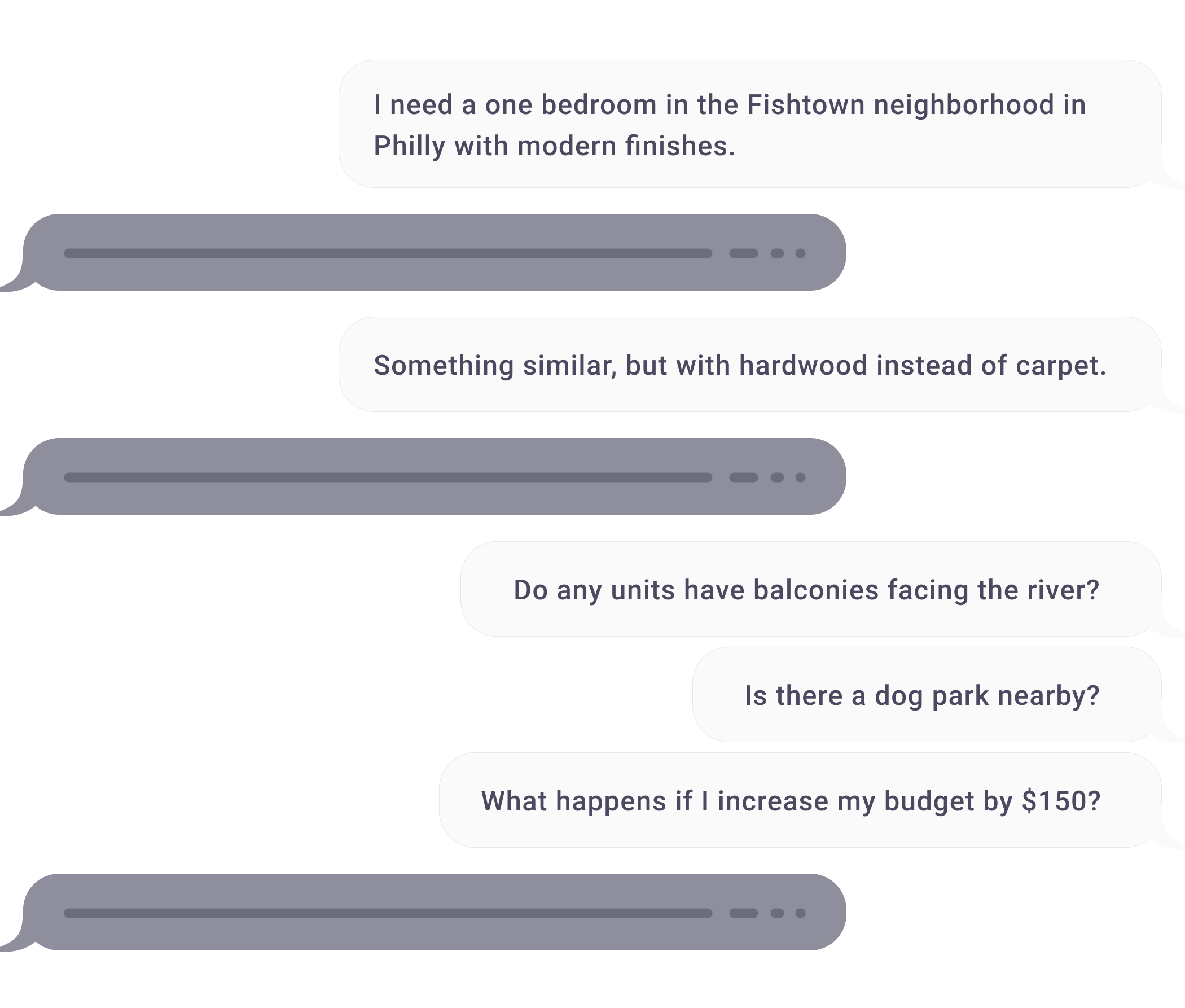
To understand why this happens, imagine a renter’s search journey inside an AI conversation:
Query 1 “I need a one bedroom in the Fishtown neighborhood in Philly with modern finishes.”
Query 2 “Something similar, but with hardwood instead of carpet.”
Query 3 “Do any units have balconies facing the river?”
Query 4 “Is there a dog park nearby?”
Query 5 “What happens if I increase my budget by $150?”
An AI model can only resolve those questions if they have access to your community’s unit-level data. If a building is objectively the best match but the model cannot discover its finishes, availability, orientation, amenity set, or neighborhood context, then it will never surface as the answer.
So, what can operators and marketers do?
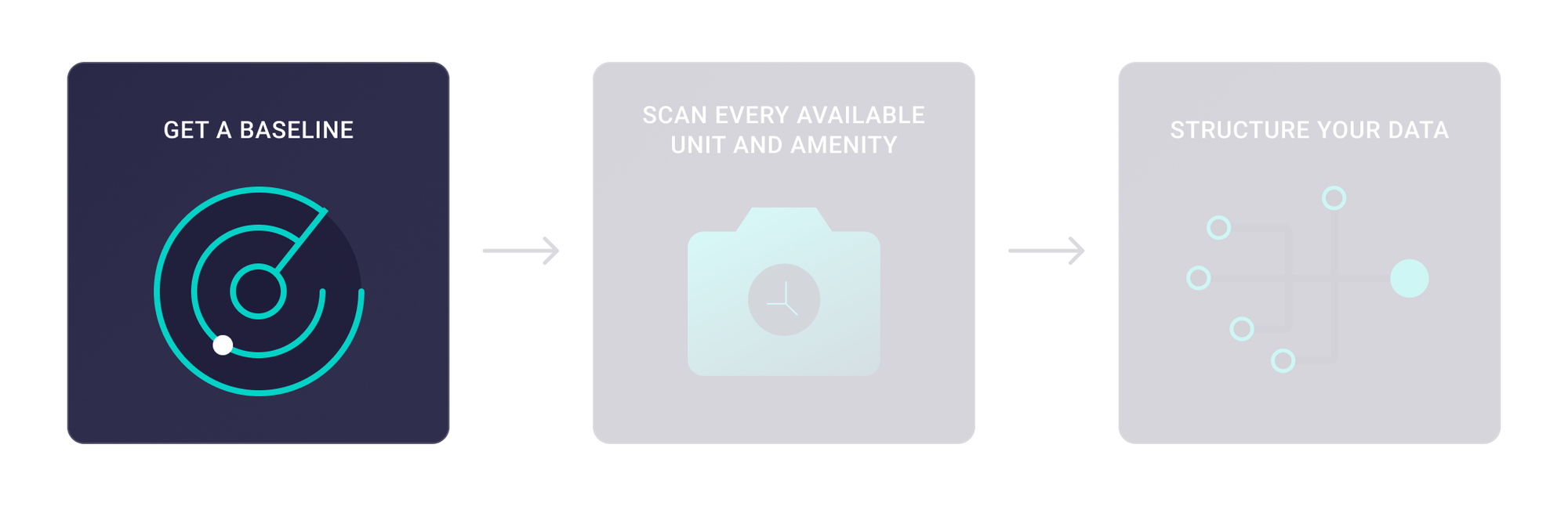
Get a baseline:
Before you fix anything, you need to understand how you’re currently performing in AI search. There are increasingly more answer engine optimization (AEO) tools on the market, although most still revolve around brand recognition. They’ll tell you whether an AI model recognizes your property name, but they don’t address the real question: Can the model identify and return the specific units that match what a renter is actually asking for?
Out of the nearly 60,000 communities we studied, many had no mentions at all. Of those that did, over 30,000 had only one mention among the thousands of queries.
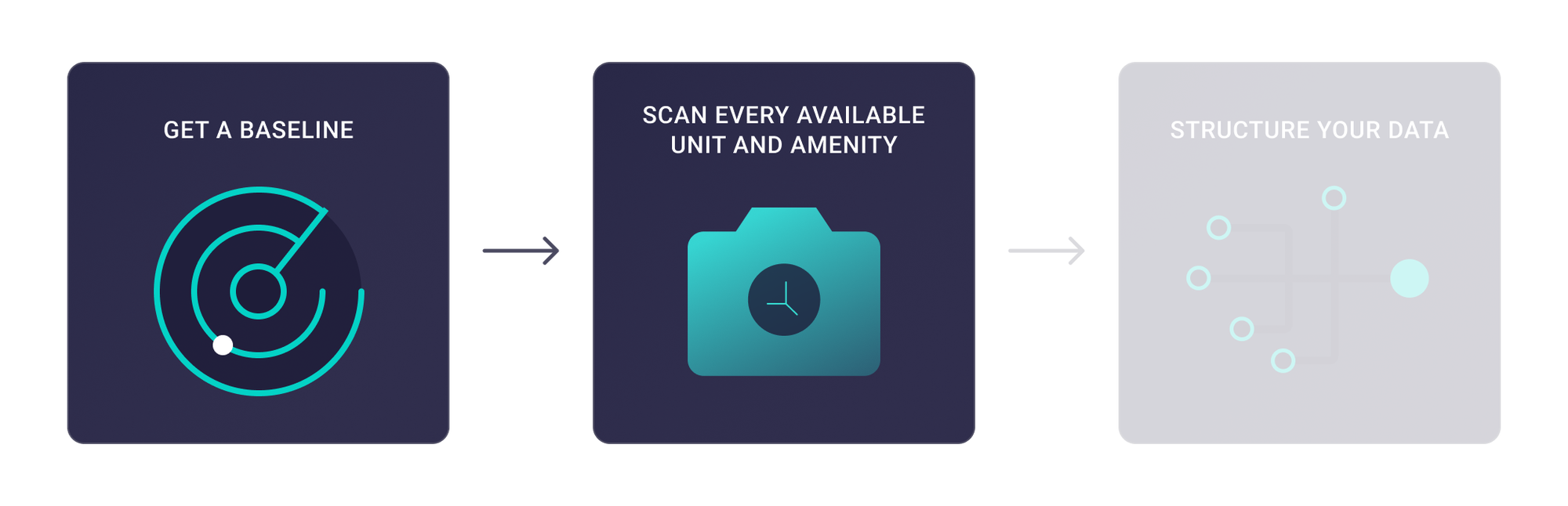
Scan every available unit and amenity:
We’ve seen properties with brand-new, renovated pools score zero on pool-related AI queries simply because the model couldn’t discover the amenity existed. The same thing happens at the unit level. If units or amenities aren’t scanned, documented, and discoverable, even your biggest investments can disappear in highly specific, renter-driven conversations.
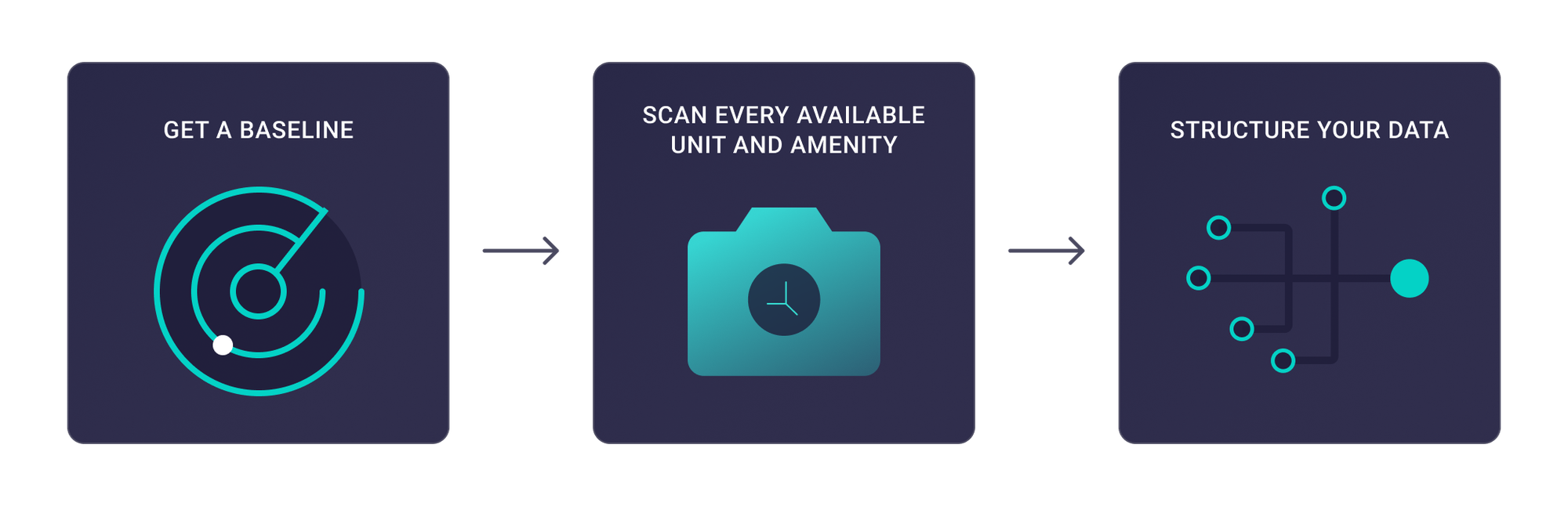
Structure your data:
Packaging your property and unit information in a format AI models can use and prioritize is increasingly important. LLMs are moving away from crawling scattered websites because it is too costly. One query can use as much energy as it takes to cook a steak.
AI tools want clean, structured, machine-readable feeds that make it fast and inexpensive to answer renter questions directly. The clearer the data, the fewer guesses a model has to make, and the lower the cost to serve a result.
If you’re wondering how your community is actually showing up in AI search, we just launched Peek Discover to help answer that. It tracks AI visibility across major LLMs and the renter questions that matter most. You can pull a free report here — and if you want to swap notes on AI strategy, unit-level tours, or whether chatbots should replace therapists, my inbox is open at audrey@peek.us.
Peek Wrapped
We’re proud of what our customers accomplished in 2025.
Some highlights:
- 30% faster leasing
- $55K in annual vacancy savings per community
- 1M hours spent touring virtually
- 13M virtual and AI self-guided tours
All of this activity helped power a new computer vision model that helps track unit-level feature and amenity demand across Peek communities—turning tour behavior into actionable insights.
You can see more of these stats in the full video. If you want to learn more about Peek Insights, reach out to robert.nyborg@peek.us.
Peek x Apartment List Partnership
Apartment List customers who sign up for the LIFT program can now activate Peek's unit-level 3D touring platform—complete with automations to take the implementation burden off of marketing and onsite teams.
Sign up by 12/31/25 and be on LIFT through March 31, 2026.
Once you onboard with Peek, you’ll get:
- 3 months of photography fees covered.
- 6 months of subscription fees included.
More leases from your leads, without more work for your teams. If you’d like to set up time with our team, send us a note at sales@peek.us.

Did you receive this as a forward? Or want to send it along to a friend?
Sign up for The Unlock here.